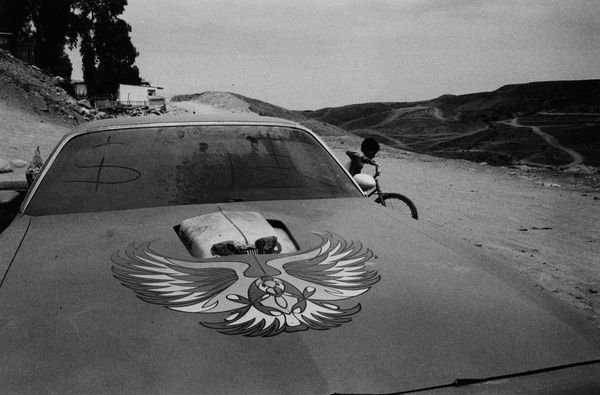
Graciela Iturbide: White Fence, Los Cholos
-

ROSEGALLERY is pleased to present White Fence, Los Cholos, an exhibition of photographs made by Graciela Iturbide in East Los Angeles in 1986.
On May 2, 1986, an assignment for the landmark documentary photographic project A Day in the Life of America brought Iturbide to an apartment in the East L.A. neighborhood of Boyle Heights. There, she was welcomed into a household of young men and women connected to the historic White Fence gang. Named for the white picket fence that surrounded La Purísma Catholic Church (the early gathering place for a youth group and sports team formed by a group of young Mexican American men), following the second World War, the White Fence gang developed into one of the most prominent gangs of the twentieth century. When Iturbide arrived, the community was facing not only intense gang violence, but crises of addiction and police brutality.
When deciding on a location to photograph, Iturbide consulted with the Los Angeles Photo Center and Sister Karen Boccalero of Self-Help Graphics. Through them, she met Margaret Garcia, an artist and longtime resident of East L.A., who introduced Iturbide to the White Fence members. Many of the individuals-among them Rosario, Lisa, and Christina-that Iturbide met that day were Deaf or hard of hearing as a result of the rubella epidemic that swept the United States in the mid-1960s, falling hardest on Latinx families with unequal access to prenatal care and treatment. They communicated largely through sign language. While in many of Iturbide's photographs, they are forming White Fence signs with their hands in expressions of pride, in others, they are speaking-a detail is worth pausing on, as these gestures could result in arrest if mistaken for gang signs.
While Iturbide's assignment called for only a brief connection, it turned into something else entirely-an act of trust that extended across more than three decades. Between '86 and 2019, she returned to Boyle Heights several times. These visits resulted in White Fence, Los Cholos, a body of work that follows a community that, in many ways, exists on the fringes. Neither fully of Mexico nor of the U.S. landscape that surrounds them, they belong to the in-between place that they have made together.
The photographs in this exhibition were all made during Iturbide's first trip in 1986, and thus offer a window into the single encounter from which a lifelong friendship would emerge. They are the beginning of a visual story that spans a generation-the young individuals in these images grow older, raise children, and build their lives together.
Over time, the name White Fence has taken on another meaning for the community, serving as a poignant metaphor for the physical, racial, and social marginalization of the Chicanx communities who hold deep roots and influence in this region, whose ancestors lived on this land before its colonization. Iturbide sought to honor the complexities of this diasporic community: White Fence, Los Cholos is neither elegy nor exposé, but something rarer-a tender, unguarded portrait of families fighting, together, to endure.
All Vintage Prints are also available as Contemporary Prints
-
-
Cholos Harpys, White Fence, East L.A., Estados Unidos
-
Cholas (Los mariachis), East L.A., Estados Unidos
-
Cholos in East LA.
-
Sin Titulo, White Fence, East L.A.
-
Christina y Rosario en su coche, White Fence, East L.A.
-
Rosario y su bebe
-
Sin Titulo, East L.A.
-
Cholos in East L.A.
-
Los Amantes, East L.A.
-
Cholo, White Fence, East L.A.
-
Rosario, Christina y Ester, White Fence, East L.A.
-
Cholos en el Parque, East L.A.
-
Cholos in the park, White Fence, East L.A.
-
Virgen de Harpys, White Fence, East L.A., Estados Unidos
-
Cholos, White Fence, East L.A.
-
Cholos, White Fence, East L.A.
-
-
La Frontera
Graciela Iturbide's searing meditation on the U.S.-Mexico border, La Frontera, was made in Tijuana between 1989 and '90.
In 1989, two years after she made the first photographs of the White Fence community in Boyle Heights on assignment for A Day in the Life of America, Iturbide returned to Los Angeles, where she continued to photograph, the extended family led by Rosario, Lisa, and Arturo. On this trip, she also traveled further South, where she turned her camera toward Mexican nationals in Tijuana-impoverished, marginalized people living at the threshold of a life they longed for, just beyond reach. The resulting images are intimate portraits of longing, resilience, and the ache of a border that both divides and defines.
Though migrants ultimately did not know what they would find there, the other side of the border represented hopeful possibilities-the American Dream. In the most indelible image in La Frontera, a man stands facing away from the camera, looking toward the arid Tijuana landscape. A tattooed portrait of the Virgin of Guadalupe covers his back-faith carried on the body, facing North.
Together, the images in La Frontera and White Fence, Los Cholos reinscribe the notion that, while a physical barrier, a border is ultimately also an imagined, social construct. Iturbide traces the shared culture, iconography, aspiration, and resistance that flows between Mexican and Mexican American communities living on both sides of this fraught landscape.
All Vintage Prints are also available as Contemporary Prints
-